How a Word's Meaning Depends on Its Neighbours
Learn how a word's meaning depends on its neighbours, with practical ways to resolve ambiguity in sentences without guessing from the word alone.
When a recipe says to “fold in the flour,” it probably does not mean to bend the flour like a sheet of paper. The surrounding words point to a familiar cooking action. If you are stuck on a word with several meanings, the useful question is not just “What can this word mean?” but “Which meaning fits the words and sentence around it?”
Word meaning depends on neighbours: nearby words, sentence structure, and the subject being discussed all help narrow the choices. Readers can still get tripped up, especially when a sentence is short, unfamiliar, or deliberately playful. A few small checks can help you work out what is happening without reaching for a dictionary at every pause.
When one word offers too many choices
Some words have several established meanings. “Bank” can name a financial institution or land beside a river. “Bright” can describe strong light, vivid color, or a clever person. The word itself presents possibilities; its neighbours help select among them.
A common snag is treating the first meaning that comes to mind as the only one. If a reader sees “The fisherman sat on the bank,” a financial meaning may briefly appear, but “fisherman” and “sat on” make the riverside sense more fitting. The sentence is not hiding a secret code. Its parts provide clues that work together.
What to try: Name two plausible meanings, then check which one makes sense with the other words. Do not settle on a choice simply because it is the most familiar.
When nearby words point in different directions
A single neighbour can be misleading. In “The bright student sat by the bright window,” the first “bright” describes the student, while the second describes the window. The noun after the adjective changes which meaning fits. Reading only the word and its closest neighbour may not provide enough information.
Structure matters because it shows how words connect. In “The duck watched the child,” “duck” is the watcher. In “The child watched the duck,” the same nouns are present, but their roles have switched. Word order can settle who did what, even when vocabulary alone cannot.
What to try: Read the whole clause and identify the word’s grammatical job. Ask what it describes, what action it performs, or which object it names. Then check whether that connection supports the meaning you picked.
When the sentence is too short
Short messages often leave out clues. “I saw her bat” could refer to an animal or a piece of sports equipment. Without a larger conversation, both readings may remain possible. That is not a failure of reading; sometimes the sentence simply does not contain enough information to choose.
Look beyond the sentence for a topic, earlier statement, or follow-up. A line about a baseball game makes one interpretation more likely; a discussion of animals points toward another. If neither context is available, it is reasonable to keep both possibilities in mind instead of pretending the ambiguity has vanished.
What to try: Check the surrounding paragraph or conversation. If the intended meaning still matters and remains unclear, ask a brief question or phrase your own reply so it does not depend on guessing.
When the topic feels unfamiliar
Context includes more than nearby vocabulary. It also includes what the conversation is about. In a computer discussion, “mouse” is likely to mean a device; in a description of a garden, it is more likely to mean an animal. If you do not know the topic, even clear sentence structure may leave a word uncertain.
Say you are reading, “The mouse stopped responding,” with no other information. You might first picture an animal, but a sentence about clicking a screen makes the device interpretation fit. The observable clue is the activity around the word, not a special meaning hidden inside “stopped responding.”
What to try: Identify the subject of the passage before choosing a sense. If the topic contains unfamiliar terms, use a reliable glossary or dictionary entry to check which meanings belong to that field.
When an expression is not literal
Some phrases use familiar words in a meaning that belongs to the whole expression. “Break the ice” usually describes easing tension, not damaging frozen water. Reading each word separately can produce a technically possible but plainly awkward interpretation.
Notice whether the literal reading fits the people, action, and situation. If a host tells guests to “break the ice” before a conversation, the social setting points toward the figurative sense. If someone is standing on a frozen pond, a literal reading could make sense instead.
What to try: Consider the phrase as a unit, then compare its figurative and literal readings with the scene. A dictionary may list the expression separately from the meanings of its individual words.
When context is not enough?
How many words should I reread?
Start with the whole sentence, then look at the sentence before and after it if needed. The wider passage may supply a topic or referent that the immediate neighbours leave out.
Should I look up every ambiguous word?
No. If one meaning fits the grammar and subject, you can usually keep reading. Look it up when the uncertainty blocks understanding or when precision matters for what you are doing.
Can punctuation change a word's meaning?
Punctuation can clarify how a sentence is grouped, which may affect how its parts connect. It cannot always settle an ambiguous word by itself, so read the surrounding wording as well.
What if two meanings still fit?
The sentence may genuinely allow both readings, or the passage may not provide enough context. Keep the uncertainty open, check a suitable reference, or ask the writer what they intended.
A useful reading order
When a word stalls you, work through the clues in a steady order:
- List the meanings that seem plausible, rather than choosing instantly.
- Check the word’s grammatical role and its connection to nearby words.
- Read the complete sentence for clues about who did what.
- Look at the passage or conversation for its topic and shared references.
- Consider whether the phrase is figurative or belongs to a specialized subject.
- Use a dictionary or glossary if important uncertainty remains.
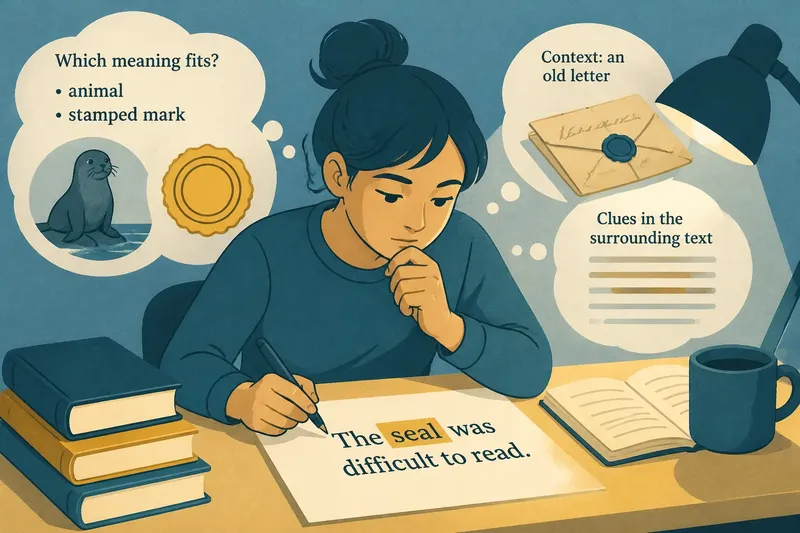
Imagine a student meets “The seal was difficult to read” in a passage about an old letter. The student could consider an animal or a stamped mark, then notice that “difficult to read” fits a mark on a document better. The student checks the preceding sentence, sees that it describes a letter, and settles on the intended sense. If the paragraph never mentions a document, asking what kind of seal the writer means would be more sensible than guessing.
It is not worth pausing over every word with multiple dictionary entries. That can turn ordinary reading into a string of detours. Focus on ambiguity that changes the sentence’s meaning, and use neighbours, grammar, and topic together; the phrase “word meaning depends on its neighbours” is a practical reminder to read connections, not isolated items.