Why Zero Makes Place Value Work
Why zero makes place value work: learn how an empty place keeps 204 distinct from 24 and helps you read each digit’s value correctly.
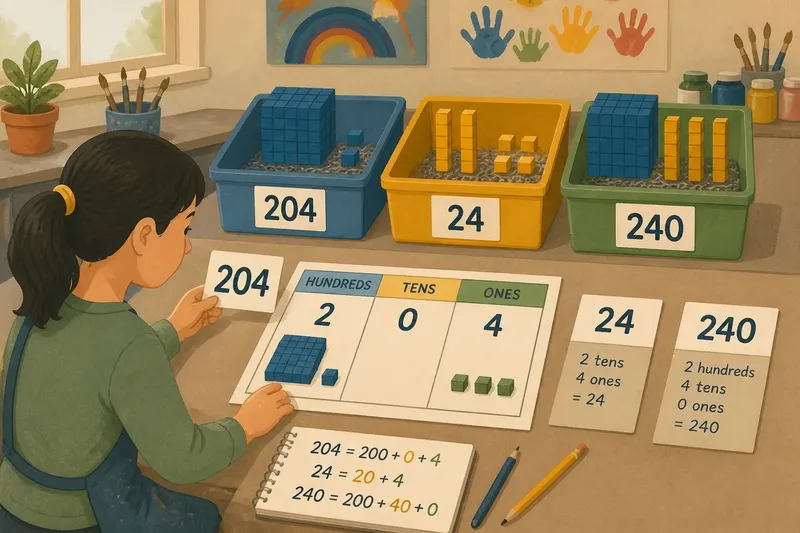
Why does 204 mean two hundred four, while 24 means twenty-four? Zero makes place value work by marking an empty tens place, keeping the 2 in hundreds and the 4 in ones. Without that marker, the digits would shift together and name a different number.
Say you are labeling three supply bins in a school art room: one holds 204 paper clips, another holds 24, and a third holds 240. Those are invented quantities for this example. If you remove the zero from the 204 label, it reads 24; the observable result is that the written label no longer matches the intended count.
Digits and places
Our familiar base-ten system organizes whole numbers into places that grow by powers of ten as you move left. In a three-place numeral, those places are hundreds, tens, and ones. Each place can hold a digit from 0 through 9.
For 204, the place-value reading is:
- Hundreds: 2 hundreds, or 200.
- Tens: 0 tens, or 0.
- Ones: 4 ones, or 4.
The parts add to 200 + 0 + 4, which is 204. The zero adds no tens, but it tells the reader that the 4 is in the ones place rather than the tens place. It contributes no quantity in that column while still carrying structural information.
Compare 24: it has 2 tens and 4 ones. Written with three places, it can be shown as 024. The leading zero marks an empty hundreds place, but it can be omitted without changing the values of the other digits. The zero inside 204 cannot be omitted in the same way, because it holds the 2 and 4 apart.
Zero and place value
In a numeral such as 204, zero acts as a placeholder: it marks a place with no units of that size. It is not merely blank space. A blank could mean that a digit was lost, copied incorrectly, or never supplied.
Consider 2,004. It represents two thousands, zero hundreds, zero tens, and four ones. The two middle zeros keep the 2 and 4 in their intended places. Remove them and the remaining digits close up to form 24, which names a different whole number.
In 2,400, the final zeros mark empty tens and ones places. They help express the number’s whole-number structure. Leading zeros, internal zeros, and trailing zeros do not all behave alike, and decimals or measurement labels may follow additional conventions.
Reading a changed numeral
If the art-room label changes from 204 to 24, the value of the digit 2 changes from 200 to 20. The 4 stays in the ones place, but the 2 moves from hundreds to tens. That is a change in the number, not just a shorter spelling.
A useful check is to read a numeral in expanded form. For 204, say “two hundred plus zero tens plus four.” For 24, say “two tens plus four.” Different place names mean the numerals do not represent the same quantity.
Imagine the art-room student has cards labeled 204, 24, and 240, all for the invented bin counts above. The student first writes the digits in a hundreds-tens-ones chart: 2, 0, 4 for the first card. Next, the student reads each column aloud, yielding two hundreds, no tens, and four ones. Finally, the student compares that reading with 24 and 240: the first card is 204, the second is 2 tens and 4 ones, and the third is 2 hundreds and 4 tens. The resulting decision is to keep the internal zero on the 204 card, because removing it changes the label’s value.
Clear arithmetic columns
Place value also explains why written arithmetic lines up digits in columns. In the invented art-room situation, adding 35 paper clips to 204 means pairing ones with ones, tens with tens, and hundreds with hundreds. The columns make those units visible; writing 204 as 24 would misstate the starting quantity before the addition began.
A place-value chart labeled hundreds, tens, and ones can help a learner see the positions. Put 2 in hundreds, 0 in tens, and 4 in ones. The chart makes the written numeral follow from the arrangement rather than from guesswork.
It is not worth adding leading zeros to every number just to make it look more formal. Use them when a form or device requires a fixed number of digits; otherwise, 024 and 24 name the same whole number. The useful habit is to preserve zeros that hold an internal place open.
Questions about zero?
Does zero in 204 mean nothing?
It means there are no tens in the numeral, so it adds no tens to the total. Its position still shows that 4 is in ones and 2 is in hundreds.
Why is 024 the same as 24?
The zero at the far left marks an empty hundreds place without changing the values of the 2 and 4. Removing it does not shift those digits into new places.
Can I remove the zero from 204?
Not if you want to keep the same whole number. The digits close up, and 204 becomes 24.
Why does 240 end in zero?
In 240, the 2 means two hundreds, the 4 means four tens, and the zero marks no ones. The numeral represents 24 tens, or 240 ones.
Keeping labels clear
For the invented art-room labels, the student checks each digit against the hundreds, tens, and ones places. The 2 in 204 belongs in hundreds, the 4 in ones, and the zero records no tens. The labels 204, 24, and 240 now remain distinct when read.
Place value is the system that connects a numeral’s written structure with the quantity it names. When zero marks an empty place, it keeps the other digits where they belong. If you are unsure whether a zero can be removed, read the numeral by place: that simple check shows whether the number would change.