From Heat to Temperature: What the Two Words Measure
Heat and temperature describe different things: learn what each measures, why objects cool at different rates, and how to read everyday examples clearly.
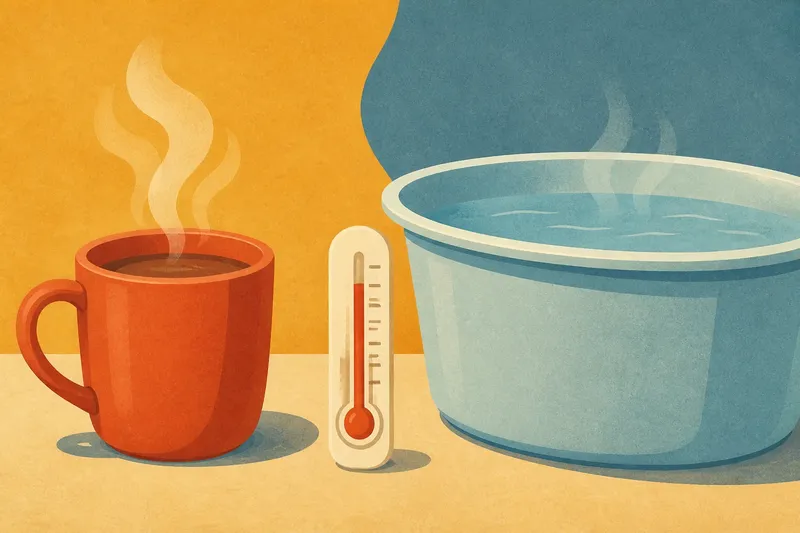
Why can a small mug of hot tea feel more intense than a large tub of warm water, even though the tub contains far more thermal energy? The answer starts with the difference between heat and temperature. Temperature describes an object’s thermal state; heat describes energy moving from one place to another because of a temperature difference.
Keeping those meanings separate makes familiar events easier to explain, from a spoon warming in soup to ice melting in a drink. Here are six useful ways to keep the concepts straight.
1. Temperature describes a state
Temperature tells you how hot or cold something is in a measurable sense. It is a property of the material at a particular moment, commonly reported in degrees Celsius, Fahrenheit, or kelvins. A thermometer reaches a thermal balance with what it touches, then indicates a temperature.
At the particle level, temperature is closely related to the average kinetic energy of the particles in a substance. In plain terms, it tracks the average energy associated with their motion, though the details depend on the material and its physical state. It does not tell you the total energy held by the whole object.
That distinction explains why temperature alone cannot tell you how much energy would be needed to warm something. A small metal bead and a large pot of water can have the same temperature while differing greatly in mass and in the energy required to raise their temperatures by the same amount.
2. Heat describes a transfer
In physics, heat is energy transferred between systems because they have different temperatures. It is not a substance stored inside an object, and it is not another name for temperature. Once energy has moved and the systems have reached a new state, the transfer has happened; the object itself has an internal energy, not a quantity called “heat” waiting inside it.
Energy flows spontaneously from warmer regions toward cooler ones. Put a cool metal spoon into hot soup, and energy transfers from the soup into the spoon. The spoon’s temperature rises, while the soup cools slightly. The word heat describes the energy crossing between them; the word temperature describes the changing condition of each.
In everyday speech, “the heat in the room” often means warmth or thermal energy generally. That phrasing is understandable, but it can blur the physics distinction. When precision matters, ask whether you mean an object’s current temperature, its internal energy, or energy being transferred.
3. Size changes total energy
Temperature is an intensive property: it does not simply grow when you combine more of the same material at the same temperature. Mass, by contrast, affects how much internal energy a system can contain at a given temperature, alongside the material and its state.
Imagine two bowls of water, one holding a spoonful and the other holding a full kettle’s worth. Both sit at the same temperature. If each receives the same small amount of energy, the spoonful will generally warm more because that energy is shared among less water. The observable result is a larger temperature change in the smaller sample, assuming comparable conditions.
This is also why a swimming pool can hold much more thermal energy than a cup of hot coffee while having a lower temperature. The pool contains vastly more matter. “Hotter” answers a temperature question; “more total internal energy” is a different comparison.
4. Materials respond differently
Equal energy transfers do not produce equal temperature changes in every material. Water’s temperature changes relatively slowly compared with many metals under similar conditions, because a given mass of water needs more energy for the same temperature rise. This material property is called specific heat capacity.
That difference matters in ordinary life. A metal pan can become hot quickly on a stove, while water in the pan warms more gradually. The burner transfers energy to both the pan and its contents, but their material properties shape how their temperatures respond. Contact between them then allows further energy transfer.
Thermal conductivity adds another part to the story. It describes how readily a material transfers energy through itself. A metal spoon can carry energy from hot soup toward its handle more readily than a wooden spoon, even if both begin at the same temperature. Temperature change and the rate of transfer are related, but they are not identical properties.
5. Phase changes complicate warming
When a substance melts or boils, energy can keep transferring without an immediate rise in temperature. The added energy goes into changing the arrangement of particles rather than increasing their average kinetic energy in the usual way. This energy transfer is called latent heat, although “heat” still refers to energy in transit.
Ice melting in a drink is a familiar example. Energy moves from the warmer drink into the ice. While ice and liquid water coexist at the melting point under a given pressure, the energy transfer supports the change of state. The drink loses energy and cools, even as the ice melts without warming above that point until the phase change is complete.
This is why “more heat means a higher temperature” is not always true. During melting or boiling, the material can absorb energy while its temperature stays steady. The state of the substance matters as much as the number on the thermometer.
6. Everyday comparisons need context
Touch is a poor thermometer for comparing different materials. A metal doorknob may feel colder than a wooden door at the same room temperature because metal transfers energy away from your skin more readily. Your hand senses the rate of energy transfer at its surface, not temperature in isolation.
Room temperature readings also describe a local condition, not every surface in the room. A windowpane can be cooler than the air beside it, so energy transfers from your hand into the glass when you touch it. A thermometer placed in the air and a hand resting on the pane are responding to different materials and different paths of transfer.
What is not worth the effort: trying to rank objects’ total thermal energy from how hot they feel. Feel depends on contact, material, and the body part doing the sensing. Use a thermometer for temperature, and reserve heat for energy transferred because of a temperature difference.
Common questions?
Can an object contain heat?
In precise physics language, an object contains internal energy, not heat. Heat names energy as it crosses a boundary because of a temperature difference.
Can two objects have the same temperature but different energy?
Yes. Their masses, materials, and physical states can differ, so their total internal energies can differ even at the same temperature.
Does cold flow into a warm object?
No. Energy transfers from the warmer object to the cooler one. “Cold” describes a lower temperature; it is not a substance moving between objects.
Why does a metal object feel colder than wood?
Metal usually transfers energy from your skin more readily than wood does. If both objects are at the same temperature, that faster transfer can make the metal feel colder.
For a clear heat-versus-temperature explanation, keep asking two separate questions: what is the object’s thermal state, and where is energy moving? The thermometer addresses the first. A temperature difference identifies the direction of the second, while mass, material, and phase help explain how the transfer changes each object.