Deduction and Induction: Two Different Routes to a Conclusion
Deduction and induction answer different questions: learn what each kind of reasoning can establish and how to choose the right route for a claim.
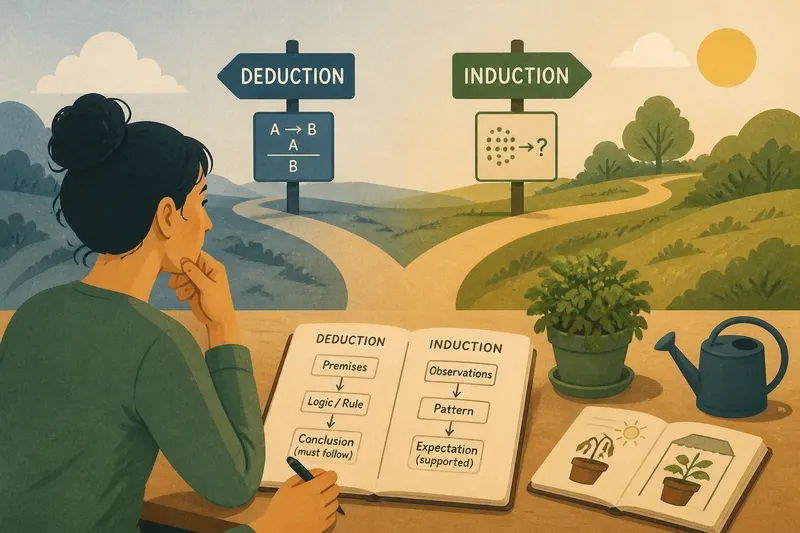
When someone says, “All the keys in this bowl open the front door; this key is in the bowl,” you can ask whether it follows that the key opens the door. Deduction and induction give different answers to that kind of question. Deduction checks what follows from stated premises; induction uses observed cases to support a broader expectation. Knowing which route you are taking helps you say exactly what your conclusion earns.
What the premises do
A premise is a statement used as a starting point for reasoning. A conclusion is the statement the reasoning is meant to support. In deduction, the central question is whether the conclusion must be true if the premises are true. In induction, the question is whether the observations make the conclusion more reasonable, even though they do not force it.
Consider a deductive pattern: “Every square has four sides. This shape is a square. Therefore, this shape has four sides.” If both premises are true and the reasoning follows the pattern, the conclusion cannot be false. The inference is valid. Whether the argument is sound depends on both validity and truth: a sound argument is valid and has true premises.
That distinction matters because a valid argument can start from a false premise. “Every bird can swim. A robin is a bird. Therefore, a robin can swim” has a valid form, but its first premise is false. Logic can show that the conclusion follows from the premises without certifying that the premises describe the world accurately.
Inductive reasoning has a different standard. A person might notice that several buses on a route arrived late during rainy weather, then expect the next rainy-day bus to be late too. The observations support that expectation if they are relevant and representative, but they do not make it certain. The next bus could arrive on time.
Deduction or induction?
Can deduction tell me a premise is true?
Not by itself. Deduction shows what follows if its premises hold; checking those premises calls for evidence, definitions, or another argument. If a premise is about the physical world, observation may be needed to assess it.
Can induction make a conclusion certain?
Ordinary induction cannot rule out every contrary case, even when its evidence is strong. It can support a confident expectation, but the conclusion remains open to revision if new or better evidence appears.
Is a prediction always inductive?
No. A prediction can be deductive if it follows from a model and premises, though the model’s fit to reality still needs assessment. Many everyday forecasts are inductive because they extend patterns from past observations to a case not yet observed.
Which route should I use?
Use deduction to examine whether a conclusion follows from assumptions, rules, or definitions. Use induction to form a general expectation from observations; if your conclusion is about a particular case, check whether the observed pattern genuinely applies there.
Certainty and support
Deduction can preserve truth across an inference: if the premises are true and the form is valid, the conclusion is true. It does not add a new fact about the world independently of those premises. Instead, it makes an implication explicit. This is why deductive reasoning is useful for checking consequences, spotting contradictions, and applying a rule consistently.
Induction can extend beyond the cases already observed. From seeing many green leaves on a particular plant, someone might expect another leaf from it to be green. That expectation reaches beyond the observations, so it carries a risk: a new leaf could differ, or the earlier observations might not represent the plant as a whole.
“Strong” and “weak” describe inductive support, rather than deductive validity. An inductive argument is stronger when its evidence is relevant, varied, and sufficient for the claim’s scope. A handful of observations from one narrow setting may support a narrow expectation, but not a sweeping rule about every setting.
Inductive conclusions also depend on how the evidence was gathered. Repeated observations can mislead if they all share the same blind spot. For example, a person who checks a garden only at noon may conclude that no birds visit, though birds could arrive at other times. The inference may be understandable, but the observation schedule limits what it can support.
Rules, patterns, and choice
Deduction is a natural fit when the task begins with accepted premises or a clearly defined rule. It suits mathematical proofs, formal logic, and practical questions such as whether a particular case meets a stated condition. The work is to make the assumptions visible, then see whether the conclusion follows without a gap.
Induction suits questions where the evidence consists of observations and the goal is to predict, generalize, or identify a likely explanation. It is common in everyday decisions as well as science: people infer what a plant needs from how it responds to light, or expect a familiar route to be busy after seeing the same pattern repeatedly. The conclusion should remain proportionate to the evidence.
Say you are deciding whether a neighborhood café usually has a quiet corner for reading. Imagine you have visited on several weekday mornings and found one, but have not been there during the weekend rush. Induction supports expecting a quiet corner on another weekday morning; it does not establish that the café is always quiet. If the café states that its upstairs room is reserved for reading, deduction can apply that rule to a visit when the room is open, while leaving the truth and current status of the stated rule to be checked.
A useful choice begins with the kind of claim you want to make. If you are asking, “Does this conclusion follow from these statements?”, use deduction. If you are asking, “What should I expect from this pattern of observations?”, use induction. Some arguments combine them: observations suggest a general rule, and deduction then draws a consequence from that rule.
Where they meet
Reasoning in practice often moves between the two. Imagine a gardener notices that a certain herb wilts in a sunny windowsill but looks healthier in a shaded spot. That observation may support an inductive expectation that the plant prefers less direct sun. If the gardener then uses a stated care rule—“Plants that wilt from direct sun should be moved away from the window”—to decide what to do with this herb, the application is deductive, assuming the rule and observation fit the case.
The two routes can also check one another. An inductive pattern may suggest a rule, while deductive reasoning reveals what else the rule would imply. If one of those implications clashes with a well-established observation, the rule may need revision. This does not turn deduction into a way of discovering every premise; it gives a disciplined way to test the consequences of a proposed idea.
In an argument, look for words such as “therefore” and “because,” but do not decide the reasoning type from a single signal word. Ask instead whether the premises are intended to make the conclusion unavoidable, or to make it more likely. Then inspect the premises themselves: a neat inference can still rest on a doubtful assumption, and a plausible pattern can still be too narrow.
It is not worth forcing every everyday thought into a formal proof or treating every observation as a sweeping rule. Often, the useful move is simply to qualify the claim: “This follows if the rule applies,” or “These cases make it likely, though not certain.” That small adjustment keeps the conclusion honest.
When you hear a confident conclusion, ask what kind of support stands behind it. Deduction can establish what follows from premises; induction can justify an expectation that reaches beyond observed cases. The distinction is not a contest over which route is better. It is a way to match the strength and wording of a claim to the kind of reasoning that supports it.